SEO for Startups
A practical 7-step SEO guide for founders: keyword research, on-page basics, technical fixes, and link building on zero budget.
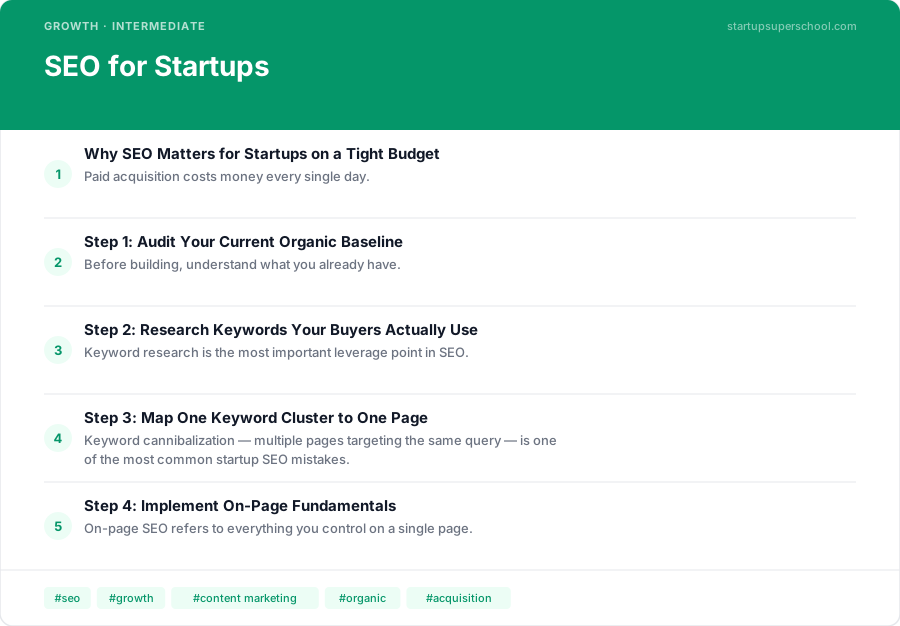
Why SEO Matters for Startups on a Tight Budget
Paid acquisition costs money every single day. SEO compounds - a post that ranks today keeps sending traffic for years. According to BrightEdge, organic search drives 53% of all website traffic on average, more than paid and social combined.
For startups, SEO is not about chasing millions of monthly visitors. It is about capturing high-intent searchers at the exact moment they look for what you sell. A founder selling B2B project management software does not need to rank for “project management” (dominated by Asana and Monday.com). She needs to rank for “project management tool for construction teams” - a specific query with far less competition and a buyer at the end of it.
This guide covers every step a non-specialist founder needs to go from zero organic traffic to a repeatable SEO engine, using only free or near-free tools.
Step 1: Audit Your Current Organic Baseline
Before building, understand what you already have.
Connect Google Search Console (GSC) to your domain at search.google.com/search-console. Add your site as a property and verify ownership via a DNS TXT record or HTML file. GSC shows which URLs Google has indexed, which queries trigger impressions, click-through rates, and crawl errors.
Wait at least 2–4 weeks before drawing conclusions - GSC only shows data from when tracking was enabled.
What to look for in your GSC audit:
| Signal | What It Tells You |
|---|---|
| Queries with impressions but 0 clicks | Good candidates for on-page optimization |
| Pages with crawl errors (404, redirect errors) | Fix immediately - they waste crawl budget |
| Average position 8–15 on key terms | Low-hanging fruit - a content improvement may push to page 1 |
| Core Web Vitals failures | Technical issues hurting rankings and UX |
If your site is brand new and has no data yet, skip to Step 2 and return to this step after 30 days.
Step 2: Research Keywords Your Buyers Actually Use
Keyword research is the most important leverage point in SEO. Pick wrong keywords and all your content effort returns nothing.
The founder’s keyword research stack (all free):
- Ahrefs Webmaster Tools - free for your own domain; shows what you already rank for and backlink profile
- Google Keyword Planner - requires a Google Ads account (free to create); shows monthly search volumes
- Google Search autocomplete and “People also ask” - the fastest way to find long-tail queries your audience actually types
- AnswerThePublic (free tier) - generates question-based keyword variants
How to build your keyword list:
- Start with 5–10 seed terms that describe your product or the problem you solve
- For each seed term, look at the autocomplete suggestions and the “related searches” at the bottom of Google results
- Export everything to a spreadsheet with columns: keyword, estimated monthly volume, difficulty score (0–100 from Ahrefs), current position (from GSC)
- Prioritize keywords with: volume above 100/month, difficulty below 30, and commercial or informational intent matching a page you can build
Example keyword prioritization for a payroll SaaS targeting small businesses:
| Keyword | Monthly Volume | Difficulty | Intent |
|---|---|---|---|
| ”payroll software for small business” | 8,100 | 62 | Commercial |
| ”how to run payroll for the first time” | 1,600 | 28 | Informational |
| ”payroll checklist template” | 880 | 19 | Informational |
| ”best payroll for 5 employees” | 320 | 24 | Commercial |
The founder should target the bottom three first. The top term is dominated by established brands.
Step 3: Map One Keyword Cluster to One Page
Keyword cannibalization - multiple pages targeting the same query - is one of the most common startup SEO mistakes. When two pages compete for the same keyword, Google often ranks neither.
The rule: one primary keyword cluster per URL.
Build a content map in a spreadsheet before writing anything:
| Page URL | Primary Keyword | Supporting Keywords | Monthly Volume | Current Position |
|---|---|---|---|---|
| /blog/payroll-checklist | payroll checklist template | monthly payroll checklist, payroll steps | 880 | not ranking |
| /blog/first-payroll | how to run payroll for first time | first time payroll setup, run payroll small business | 1,600 | not ranking |
Stick to this map. If two topics are closely related, write one comprehensive page rather than two thin ones. Update the map quarterly as your rankings evolve.
Step 4: Implement On-Page Fundamentals
On-page SEO refers to everything you control on a single page. Get these right for every piece of content you publish.
The on-page checklist:
- Title tag: 50–60 characters, primary keyword near the front, no clickbait. Example: “Payroll Checklist Template for Small Business (2026)”
- Meta description: up to 160 characters, summarize what the page delivers, include a secondary keyword naturally
- One H1: matches the page’s primary keyword, appears once, at the top
- H2/H3 subheadings: cover the full topic scope, include related terms naturally - do not stuff keywords
- Body copy: answer the searcher’s question completely; a page that answers better than competitors earns both rankings and backlinks
- Internal links: link from this page to 2–3 related pages and from other pages to this new page
- Alt text on images: describe the image in plain language; include the keyword only when it genuinely fits
- URL slug: short, keyword-rich, no stop words.
/payroll-checklistbeats/blog/post/12345-the-ultimate-payroll-checklist-for-2026
Schema markup: add FAQ schema and HowTo schema where appropriate. Both appear as rich results in Google, increasing click-through rates by 20–30%.
Step 5: Fix Your Technical SEO Baseline
Technical SEO ensures search engines can crawl, index, and understand your site. A single technical issue - like blocking Googlebot in robots.txt - can make all content work invisible.
Run a free crawl with Screaming Frog (free up to 500 URLs) or the Ahrefs Site Audit (included in Webmaster Tools). Prioritize fixing:
Critical fixes (resolve within 1 week)
- 4xx errors on indexed URLs: redirect broken pages to the closest live equivalent with a 301 redirect
- Blocked resources in robots.txt: confirm your CSS, JS, and images are not blocked - Google needs to render pages to evaluate them
- Missing or duplicate canonical tags: every page should have a canonical pointing to itself (or to the preferred duplicate)
- HTTP pages on an HTTPS site: mixed content warnings and HTTP pages hurt rankings and user trust
Performance fixes (resolve within 1 month)
- Page speed: Google’s Core Web Vitals require Largest Contentful Paint (LCP) under 2.5 seconds. Compress images, defer non-critical JavaScript, and use a CDN
- Mobile usability: test with Google’s Mobile-Friendly Test - at minimum text must be readable without zooming and tap targets must be 48px+
- Structured data errors: validate with Google’s Rich Results Test; errors in schema markup prevent rich snippets
Ongoing maintenance
- XML sitemap: generate one automatically (Astro’s
@astrojs/sitemapintegration handles this) and submit to GSC - Internal link depth: no important page should be more than 3 clicks from the homepage
- Redirect chains: a → b → c is a chain; flatten to a → c
Step 6: Build Links Without a Budget
Links from other sites remain the strongest ranking signal in Google’s algorithm. Startups without PR budgets can still build links - it just requires more creativity than money.
Three zero-budget link channels:
1. Directory and tools roundup listings
Most SaaS verticals have directories (G2, Capterra, ProductHunt, GetApp) and “best tools for X” blog posts. Getting listed on 10–20 relevant directories takes 2–3 hours and produces permanent, relevant backlinks.
Search for "best [your category] tools" and "[your category] alternatives" - email the authors and offer a free account in exchange for an honest listing.
2. Guest posts for niche publications
Identify 5–10 newsletters, blogs, or trade publications in your vertical. Pitch a specific article idea - not a generic “I’d love to write for you” email. A payroll SaaS founder might pitch “The 3 payroll mistakes that trigger IRS audits for businesses under 10 employees” to a small business finance newsletter.
Guest posts in high-authority publications produce strong backlinks, referral traffic, and brand awareness simultaneously.
3. Unlinked brand mentions
Search Google for your company name in quotes, excluding your own domain:
"YourCompany" -site:yourcompany.com
When you find articles that mention your brand without linking to you, reach out to the author or editor. This is the easiest link-building tactic because the editorial decision to mention you is already made - you are just asking for the hyperlink.
Realistic link-building pace for a startup: aim for 5–10 new referring domains per month in year one. Quality matters more than quantity - a single link from a DA 70 industry publication beats 50 links from DA 10 directories.
Step 7: Measure and Iterate Every 30 Days
SEO without measurement is guesswork. Establish a monthly reporting cadence from day one.
Your SEO metrics dashboard (all from free tools):
| Metric | Source | What Good Looks Like |
|---|---|---|
| Organic sessions | Google Analytics 4 | Month-over-month growth after 3 months |
| Keyword position for top 20 targets | Google Search Console | Moving from 20+ to top 10 |
| Referring domains | Ahrefs Webmaster Tools | Growing by 5–10/month |
| Organic signups or leads | GA4 goal conversions | Non-zero and increasing |
| Click-through rate | Google Search Console | Above 3% for branded, above 1% for non-branded |
The 30-day review checklist:
- Open GSC → Performance → filter by last 28 days vs. previous 28 days
- Identify pages that dropped in position - check for content freshness, competitor changes, or technical issues
- Identify pages gaining impressions but not clicks - these are candidates for title tag and meta description improvements
- Add internal links from newly published pages to existing high-priority pages
- Review which content drove organic leads in GA4 - double down on topics that convert
After 90 days, cut or consolidate pages with zero clicks and no backlinks. Thin content can drag down your overall domain quality.
Key Takeaway
SEO for startups is not about hiring an agency or publishing 50 blog posts in your first month. It is about understanding exactly which queries your buyers type, building pages that answer those queries better than anyone else, fixing the technical foundations so Google can find and index your work, and earning links from relevant sites over time. A focused founder who spends 4–6 hours per week on SEO can build a meaningful organic channel within 6–12 months - one that keeps delivering leads long after the work is done.
Frequently Asked Questions
How long does SEO take to show results for a startup?
What free SEO tools are best for early-stage founders?
Should a startup invest in SEO or paid ads first?
What is keyword cannibalization and why does it hurt rankings?
How many backlinks does a startup need to rank?
Create an account to track your progress across all lessons.
Comments
Loading comments...